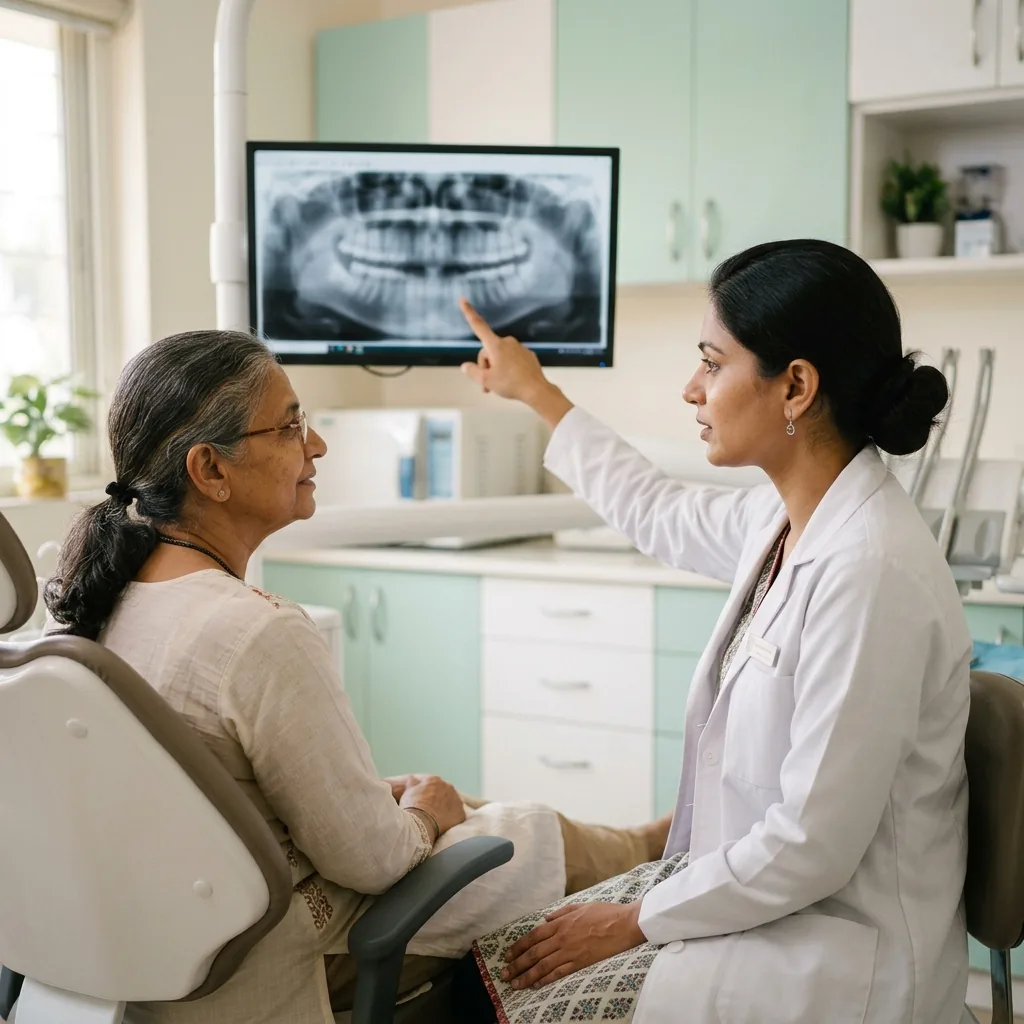
Medically reviewed by Dr. Aditi Jain, BDS, MDS · Periodontist & Oral Implantologist · with 15 years of experience·Last reviewed 11 June 2026
Full mouth rehabilitation is a planned course of treatment that rebuilds all or most of your teeth with dental implants and full-arch bridges, so a worn or failing set of teeth becomes a complete, working bite again. At Surekha Dental Clinic in Mulund West, Mumbai, full mouth rehabilitation (sometimes called full-mouth reconstruction) is done in stages under anaesthesia. We start with a digital scan and finish by fixing tooth-coloured teeth onto your implants. It suits anyone who has lost many teeth, or whose remaining teeth are badly broken down, loose or beyond saving. If years of dental trouble have left you struggling to eat or smile with confidence, our friendly team is here to plan a fresh start at a comfortable pace.
When should you consider full mouth rehabilitation?
Full mouth rehabilitation is for more widespread problems than a single filling or crown. It may be the right path if several of the points below apply to you.
Many teeth are missing and the gaps are making it hard to chew a normal meal
Several remaining teeth are loose, badly decayed or broken down to the gum
An old denture keeps slipping, clicks when you talk, or no longer fits well
Your bite feels collapsed or uneven, or your face looks shorter than it used to
Long-standing gum disease has loosened teeth across the whole mouth
You avoid smiling or eating in company because of how your teeth look or feel
Step by step
Here is exactly what happens during your full mouth rehabilitation, step by step.
1Step 1 of 4
How is your full mouth rehabilitation planned?
Your full mouth rehabilitation begins with careful planning, because rebuilding a whole mouth works best when every step is mapped out first. A small digital scanner wand is passed gently over your teeth and gums to capture a detailed 3D map of both the upper and lower arches, with no messy putty trays needed. From this scan the dentist plans the full rehabilitation, deciding which teeth need to come out, where the implants will sit, and how your new teeth will look and bite together. You simply relax while the wand does the work, feeling only its smooth tip moving around. By the end of this sitting you have a clear, personalised plan and know what each stage involves, which sets up the surgical step that follows.
2Step 2 of 4
How are failing teeth removed and the sites prepared?
Once the plan is agreed, the next stage clears the way for your new teeth. Anaesthesia is given so the whole area is numb and you should feel little to no pain, just some gentle pressure and movement. Any remaining teeth that cannot be saved, which dentists call hopeless teeth, are gently removed from their sockets. The dentist then opens a small flap of gum at each planned implant site, exposing the bone underneath so the implants can be placed accurately. Preparing the sites this carefully is what lets the implants go in exactly where the plan intended. With the old failing teeth out and the bone ready, your mouth is set up for the implant surgery in the next step.
3Step 3 of 4
How are the dental implants placed in the jaw?
With the sites prepared and the area numb, the dentist places the implants that will anchor your new teeth. Small channels, called osteotomies, are shaped in the bone, and four to six titanium implants are threaded into each arch at carefully chosen angles to make the most of the bone you have. Titanium is used because bone bonds naturally to it over time, a process known as integration. A small healing cap is fitted onto each implant and the gum is closed with fine sutures, then the implants are left to integrate, usually over a few months. You should feel only firm pressure during placement, nothing sharp. This healing period is what gives the implants a strong, stable foundation before your fixed teeth go on in the final step.
4Step 4 of 4
How are the new full-arch teeth fitted?
Once the implants have integrated with the bone, the final stage gives you back a full set of teeth. The dentist uncovers the implants and fits small connectors, called abutments, onto them. A full-arch bridge of tooth-coloured teeth, made to match the shape and shade planned at the start, is then securely attached to those implants. This fixed bridge restores a complete bite, so you can chew properly again, and gives you a natural-looking smile you can feel confident sharing. Because the teeth are anchored to implants, they stay firmly in place and do not slip the way a loose denture can. A well-cared-for implant typically lasts many years with good care. The team will show you how to clean around your new teeth so the result stays healthy.
Frequently asked questions about full mouth rehabilitation
Does full mouth rehabilitation hurt?
No, full mouth rehabilitation is not as uncomfortable as many people fear. The surgical stages are carried out under anaesthesia, so you should feel little to no pain during treatment, just some pressure. Mild soreness and swelling for a few days afterwards are normal and settle with the aftercare advice from Surekha Dental Clinic.
How long does the whole treatment take?
Full mouth rehabilitation is done in stages over several months, not in one sitting. After the implants are placed, they need time to integrate with the bone, usually a few months, before the final fixed teeth are attached. The dentist will give you a clear timeline for your mouth after the planning scan.
How long do dental implants last?
A well-cared-for dental implant typically lasts many years when you keep up good cleaning and regular check-ups. The tooth-coloured bridge fixed onto the implants may need some maintenance over time. Smoking and uncontrolled diabetes can affect how well implants heal and last.
How much does full mouth rehabilitation cost in Mulund West?
The cost depends on how many teeth need removing, how many implants each arch needs, and the type of full-arch bridge used. Every mouth is different, so there is no single fixed price. Please call Surekha Dental Clinic on +91 98334 88847 or use the booking form, and a written estimate is given after a short examination.
Am I a suitable candidate for full mouth rehabilitation?
Most people who have lost many teeth or whose remaining teeth are failing can be helped, but suitability depends on your jawbone, gum health and general health. After a digital scan and examination, Dr. Aditi Jain, BDS, MDS, our Periodontist and Oral Implantologist, will advise honestly whether implant-based rehabilitation suits you.
Is full mouth rehabilitation better than removable dentures?
It depends on what suits you. Implant-supported teeth stay fixed in place, so they do not slip while eating or talking the way a removable denture can, and they help protect the jawbone. Dentures remain a simpler, lower-cost option. The team at Surekha Dental Clinic can examine your mouth and advise.