Medically reviewed by Dr. Aditi Jain, BDS, MDS · Periodontist & Oral Implantologist · with 15 years of experience·Last reviewed 11 June 2026
An early orthodontic evaluation is a gentle dental check of how the teeth, jaw and bite are developing in a growing child, so any concern is spotted early while it is simple to guide. At Surekha Dental Clinic in Mulund West, Mumbai, the sitting is calm and child-friendly. We look at how the baby and adult teeth are coming through, capture a 3D record of both arches and a panoramic X-ray, and then sit down with you to explain what we see. Most children do not need braces straightaway, and often the sitting simply brings reassurance that everything is on track. Around the age of seven is a good time for a first look, or sooner if you have noticed crowding, a thumb habit or an uneven bite. If you are wondering whether your child will need braces one day, our friendly team is happy to take a look.
When should you bring your child in for an orthodontic check?
Many bite concerns are easiest to guide while a child is still growing, so an early look helps. Do bring your child in if you notice any of the following.
Crowded, crooked or overlapping teeth, or adult teeth coming through behind the baby teeth
Front teeth that do not meet when the mouth closes, or top teeth that sit far ahead of the bottom ones
A thumb-sucking or finger-sucking habit that has carried on past about age five
Difficulty biting or chewing, or a child who often breathes through the mouth
Baby teeth lost much earlier or much later than usual for their age
A jaw that shifts, clicks or looks uneven when your child opens and closes
Step by step
Here is exactly what happens during your early orthodontic evaluation, step by step.
1Step 1 of 3
How does the dentist check the teeth and bite at the first sitting?
The first part of the evaluation is simply a relaxed look, and the dentist keeps it light so your child stays at ease. Using a small mirror, we check how the baby and adult teeth are coming through, whether they have enough room, and how the upper and lower teeth meet when your child bites together. Nothing sharp is used, and we chat with your child as we go, so it feels like a friendly look rather than a test. Next we capture a 3D record of both arches, either with a small scanner wand that glides over the teeth or with a soft impression tray. By the end of this step we have an accurate model of the growing smile, ready for the X-ray that follows.
2Step 2 of 3
Why is a panoramic X-ray taken for your child?
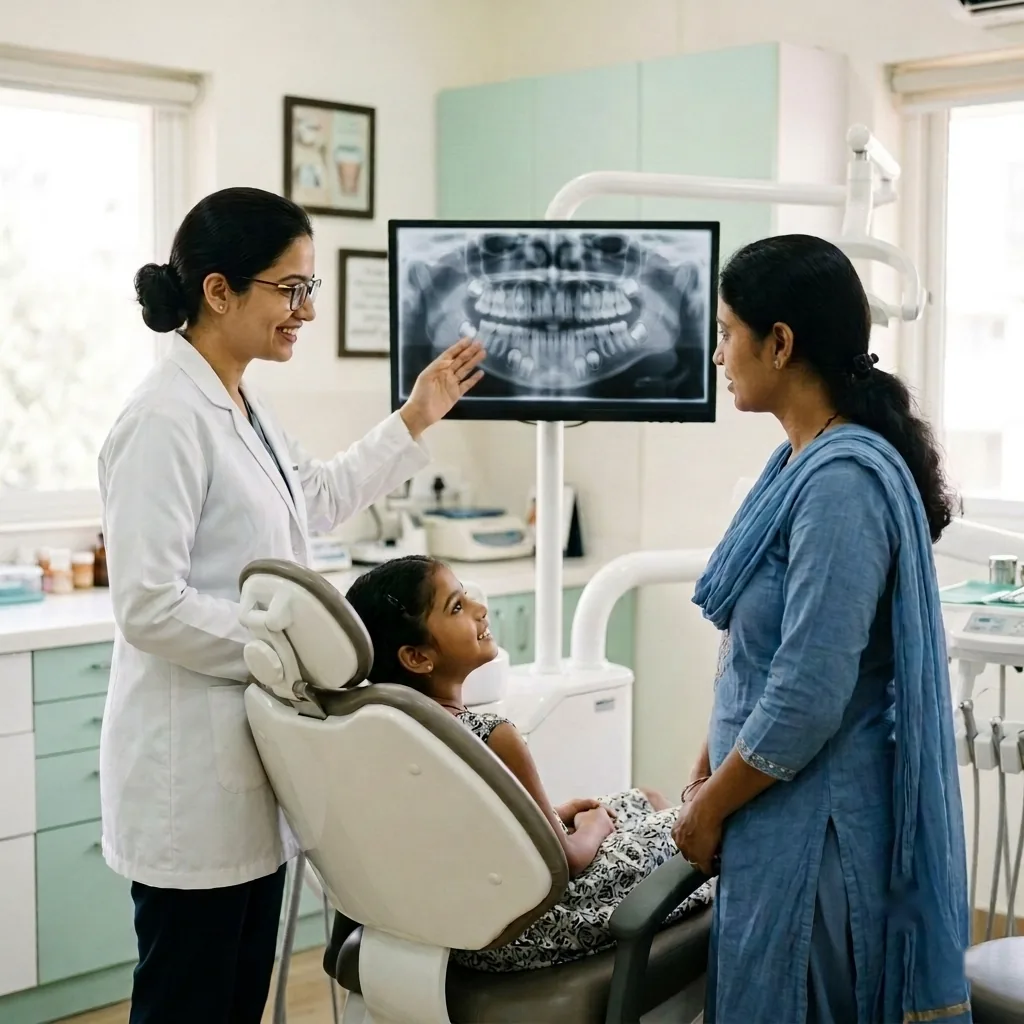
A panoramic X-ray is taken because much of what shapes a growing bite is still hidden inside the jaw. The adult teeth that have not come through yet, their size, their position and the room they will need, sit below the gum where the eye cannot reach. Your child stands still while the X-ray arm moves gently around the head, capturing one wide picture of the whole mouth in a few seconds. Nothing is placed inside the mouth, and the dose of radiation is low. The image shows the developing permanent teeth, the jawbone and any teeth that may be crowded, missing or coming in at an angle. With this inside view, the dentist can plan around how the adult teeth will arrive, not just how things look today.
3Step 3 of 3
What does the dentist explain to you afterwards?
After the check and the X-ray, the dentist sits down with you and explains the findings in plain words, with time for every question. We walk you through how the teeth and jaw are growing, point out anything worth keeping an eye on, and tell you honestly if nothing needs doing. In many cases the news is simply that everything is on track, with a review suggested in a year or so. Where an early step would genuinely help, such as guiding a developing bite or holding space for an adult tooth, we explain why, what it involves and when the right time to start would be. There is never any pressure to begin treatment. You leave knowing exactly where your child stands and what, if anything, comes next.
Frequently asked questions about early orthodontic evaluation
Does an early orthodontic evaluation hurt?
No, the evaluation is gentle and should not hurt. It is a friendly look inside the mouth with a small mirror, a quick 3D scan and a panoramic X-ray your child simply stands still for. There are no injections and nothing sharp, and most children find it easy, even interesting.
At what age should my child have an orthodontic evaluation?
Around the age of seven is a good time for a first orthodontic evaluation, because enough adult teeth have come through by then to show how the bite is forming. You are welcome to bring your child sooner if crowding, a thumb habit or an uneven bite has been worrying you.
How much does an early orthodontic evaluation cost in Mumbai?
The cost depends on what the evaluation includes, such as the 3D scan and the panoramic X-ray, and whether any follow-up review is planned. For a clear estimate for your child, please call Surekha Dental Clinic on +91 98334 88847 or use the booking form. A written cost is given after a short examination, with no obligation to proceed.
Does my child need braces if they have an evaluation?
Not usually. Most children who come for an evaluation do not need braces straightaway, and many simply need a review in a year or so. The aim is to spot concerns early so they can be guided gently if needed. If braces are advised later, the dentist explains why and the best time to start.
Is the panoramic X-ray safe for my child?
Yes, a panoramic X-ray uses a low dose of radiation and is considered safe for children when there is a clear reason to take one. It is captured from outside the mouth in a few seconds, with nothing uncomfortable placed inside. We only take an X-ray when it genuinely helps the care of your child.
How long does the evaluation take?
An early orthodontic evaluation usually takes one short sitting. The look inside the mouth and the 3D scan take only a few minutes each, the panoramic X-ray takes seconds, and the dentist then spends unhurried time explaining the findings. Most families are in and out comfortably within the one appointment.